

Should I Use A Piece Of Material To Strengthen A Boat Cover When Repairing A Rip In It
A wet transom core is not good. Hither's how to replace it yourself.
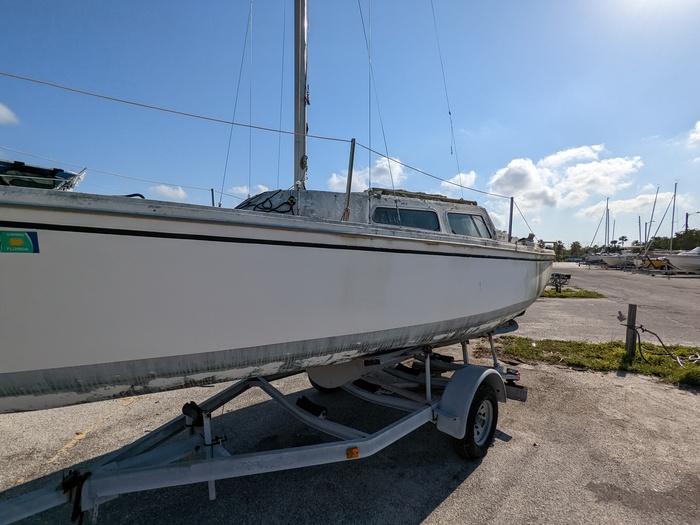
I was looking for a middle panel hull that had great seakeeping ability in order to fish offshore in Florida. I found a used 28 Whitewater hull, which was perfect considering I wanted to put some depression-60 minutes Yamahas on it. A new fully rigged 28 Whitewater costs nearly $150,000, merely I got the hull for $15,000. With engines, I would have a rugged, reliable offshore boat for about $60,000.
When I drilled a hole in the transom, water leaked out (1) , which was, to say the least, really depressing, because a surveyor gave the gunkhole a clean nib of health. Further delving revealed the transom's woods core was totally rotten (2) . Hiring a boatyard to replace the transom's core would totally blow my budget, so I did it myself.
Replacing the transom'south core from the inside is the preferred method, because it keeps the boat'due south original construction intact. The get-go pace is to gain access to the interior of the transom, and so I used a Rockwell Sonicrafter Oscillating Multi-Tool to cutting the cap and deck off the rear of the boat, which proved to be i of the easier steps. The fundamental is to not cut into the corners; doing and so makes information technology very hard to repair and can create a weak spot. When cutting back the knees/stringers that were connected to the transom, I had to cut back until I got past the rotted wood. I cutting off about six inches of a stringer (3) and could meet by its advent I was past the moisture wood. If you are uncertain, utilise a pin-type moisture meter to measure the forest's water content.
Removing the former cadre of wet wood from the transom proved to exist the nearly difficult part of this project. I started using a chisel, hammer and crowbar to remove small pieces at a fourth dimension. Some parts will be super easy if they're really rotten. At this point, the fiberglass transom had bits of leftover wood (4) , so I used a grinder to grind it all downwardly to bare fiberglass, and so used a belt sander to create the flattest possible surface. Make sure to embrace up completely. I taped my sleeves to my gloves and used a respirator. Somehow, the glass still got to my skin and itched like crazy. If — when! — that happens, utilise packing tape to pull the footing glass off your peel.
I began lamentatory up the transom by calculation a couple of layers of fiberglass to the existing fiberglass transom shell. I started with 1708 biaxial material, which has a 45-degree weave. Then I laid down 1808 biaxial material, which has a 90-caste weave. I used vinylester resin, which is orders of magnitude improve than polyester resin. I laid the cut piece of fiberglass down on a slice of plywood and practical the resin until the mat was soaked through before putting information technology in place on the transom. The key to creating a strong bail is to make sure all the bubbles are rolled out and permit it cure for at to the lowest degree 24 hours.
I used Coosa Board Bluewater 26 to supersede the forest cadre, because it doesn't absorb water and has very high pinch strength. I fabricated a paper-thin template of the transom inside where the new core was going, which I used to marker the one-and-a-half-inch Coosa Lath Bluewater 26 (5) . I cut the board with the Rockwell Multi-Tool (vi) . Belongings the board in place, I used a half-inch drill chip to drill through the existing mounting holes whenever possible in the transom, through the cured fiberglass I merely laid and then into the Coosa board. I and then placed the 2-by-fours and drilled through them, so everything lined up.
I created a thickened resin with Cabosil and put it on the fiberglass, laying it on thick with a plastic trowel and being careful to leave infinite at the edges for it to spread out. I placed the Coosa board core against the transom and bolted on the two-by-fours (7) , which acted equally a vise to create a very strong bond when fully cured. If there are any spaces between the core on the sides and lesser, utilise more than thickened epoxy and smooth information technology downward, so it's even with the Coosa board. After 24 hours, I removed the two-past-fours, filled the mounting holes with thickened resin and sanded down whatever areas that weren't smooth.
Again, using the vinylester resin, I glassed down the transom with 1708 and 1808 fiberglass mat — in this lodge: 1708, 1808, 1708, 1808 — all the fashion to the top of the transom and out iv to 8 inches on the sides and bottom (eight) . Information technology cured overnight before I trimmed excess fiberglass off the top of the transom.
I cutting out new pieces of Coosa board for the stringers/knees, to fit the old ones, and glassed them in with a layer of 1708, then 1808. Make sure the glass extends four to vi inches onto the transom, former stringers and lesser.
Terminal, I sanded and painted the area with Interlux BilgeKote primer and paint (9) . The final result is an incredibly potent transom that won't absorb water whenever I drill a pigsty.

Should I Use A Piece Of Material To Strengthen A Boat Cover When Repairing A Rip In It,
Source: https://www.boatingworld.com/diy/rebuild-rotten-transom/
Posted by: forbescousitony.blogspot.com
0 Response to "Should I Use A Piece Of Material To Strengthen A Boat Cover When Repairing A Rip In It"
Post a Comment